
All projects featured in this article belong to their respective creators. We're grateful to everyone who shares their ideas, code, and experiments with the Home Assistant community.
When we first introduced Astrion, we thought we were building a remote.
A touchscreen remote for Home Assistant. A better way to interact with lights, media players, and automations. A dedicated physical interface for the smart home.
But over the past year, something unexpected happened.
People stopped asking what Astrion could do.
Instead, they started asking: "What can I build with it?"
They didn't wait for us to define the future of Astrion. They started building it themselves.
For us, that was the moment Astrion truly became a platform.
Because a platform is not defined by what its creators build. It is defined by what others can create on top of it.
A Different Kind of Success
Most companies measure success by the number of units sold or features released.
As engineers, we've learned to look for something different.
The most exciting moment isn't when someone buys your hardware. It's when they decide the hardware is worth rebuilding. When someone spends an entire weekend writing their own launcher. When they redesign the entire interface. When they publish the code so complete strangers can use it. When other community members improve it.
That's when you realize the product no longer belongs only to you.
It belongs to the community.
Today we'd like to celebrate a few of those projects.
1. A Native Home Assistant Experience
Project by t0m1o1
One of the earliest community projects completely replaced the default experience with a native Home Assistant interface.
Instead of relying on the stock UI, the project focused on something many power users wanted: a native Home Assistant experience, page-specific physical button mapping, custom hotkeys, faster navigation, and greater flexibility.
This was an important moment for us. It showed that Astrion did not need to be defined by the software we shipped. The hardware could become a foundation for completely different experiences created by the community.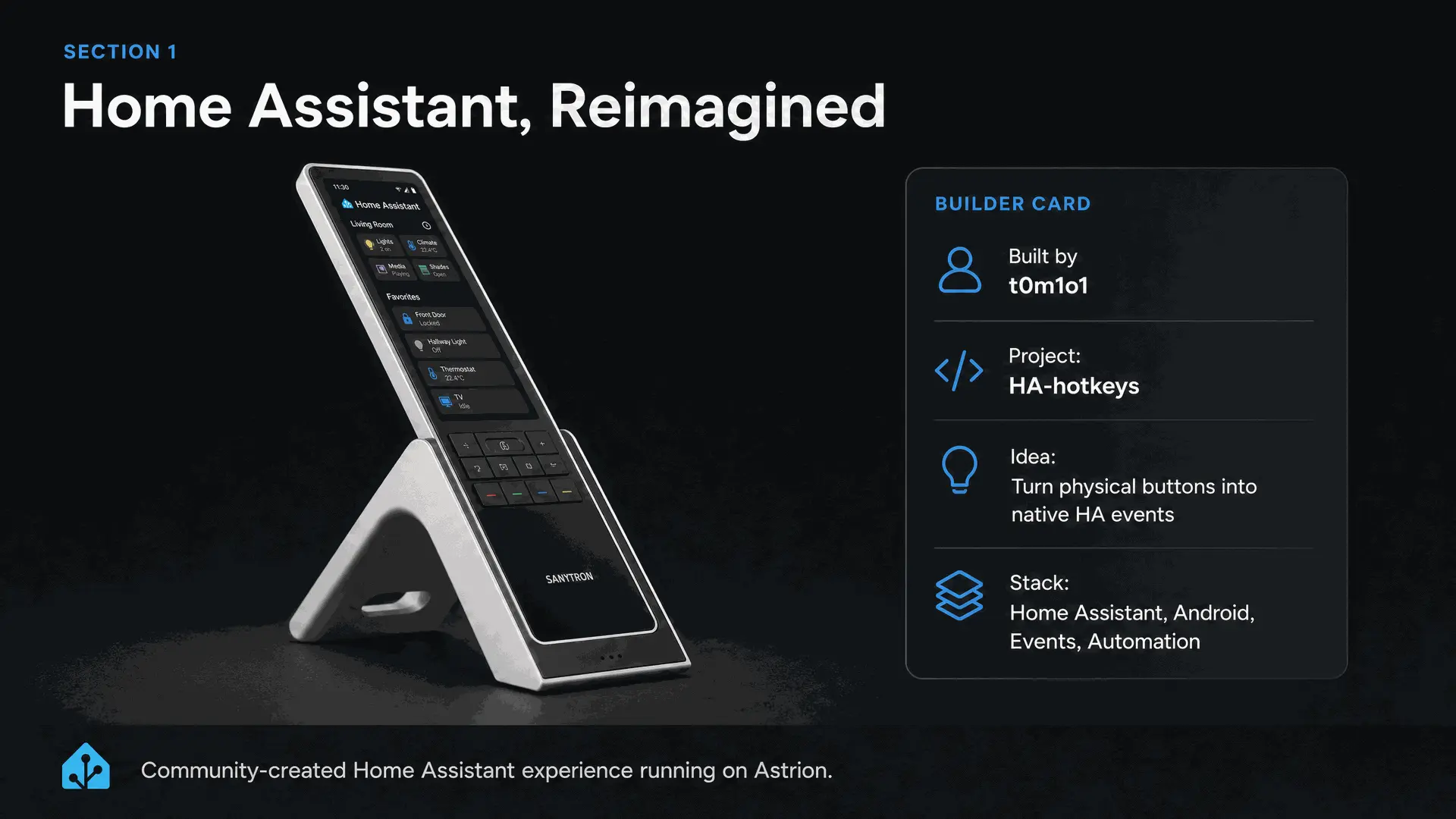
GitHub: https://github.com/t0m1o1/HA-hotkeys
2. Astrion Custom Dashboard
Project by Aurelien_PERARD
One of the most ambitious community contributions pushes Astrion into entirely new territory.
Rather than treating Home Assistant as the only source of truth, Aurelien explored a hybrid philosophy: Home Assistant is the brain of the smart home, but the remote itself should also be intelligent.
His project introduces a completely custom launcher, native Android dashboard, direct Logitech Harmony Hub integration, fully customizable physical buttons, JSON-based layouts, and an online dashboard editor. It allows multimedia control to continue working even if Home Assistant is unavailable.
Whether users choose this architecture or not, we love seeing ideas that challenge assumptions—including our own.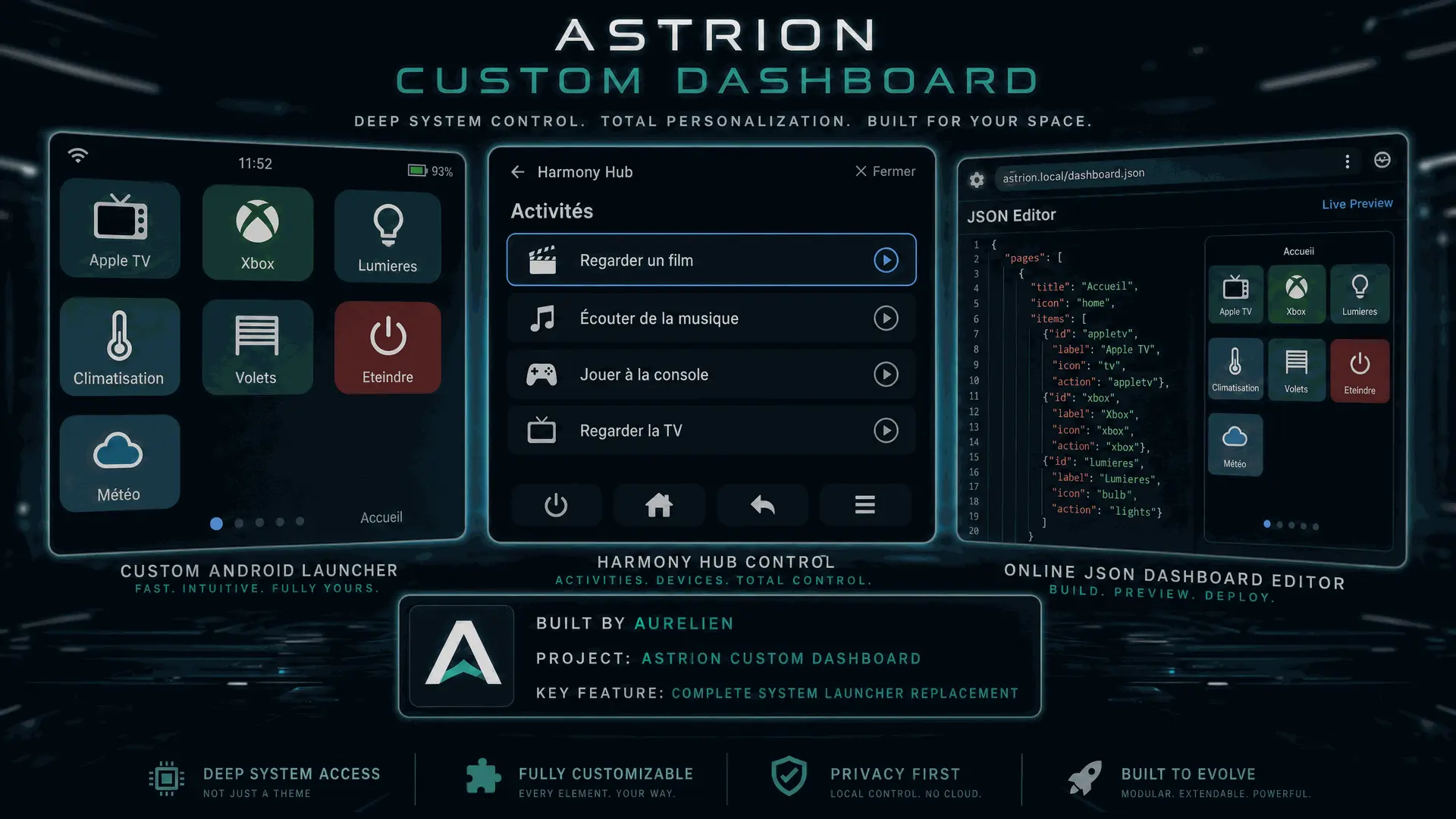
GitHub: https://github.com/dckiller51/astrion-custom-dashboard
3. A Native Kotlin Dashboard
Project by biggobird
One of our favorite recent projects comes from Reddit.
Instead of using Lovelace or a browser, this project builds everything from scratch using Kotlin and Jetpack Compose. Highlights include native rendering, instant Home Assistant updates through a single WebSocket, an interactive floorplan, Plex "On Deck" integration, Home Assistant Assist voice, battery reporting, a custom launcher, and fully remappable hardware buttons.
Perhaps our favorite sentence from the author was simply:
"No Lovelace. No browser. No cloud."
It perfectly captures one of the strongest values in the Home Assistant community: giving users the freedom to choose the architecture that fits their own home.
What impressed us most was not only the result, but the process: a user took a product, explored its possibilities, and created an entirely new experience around it.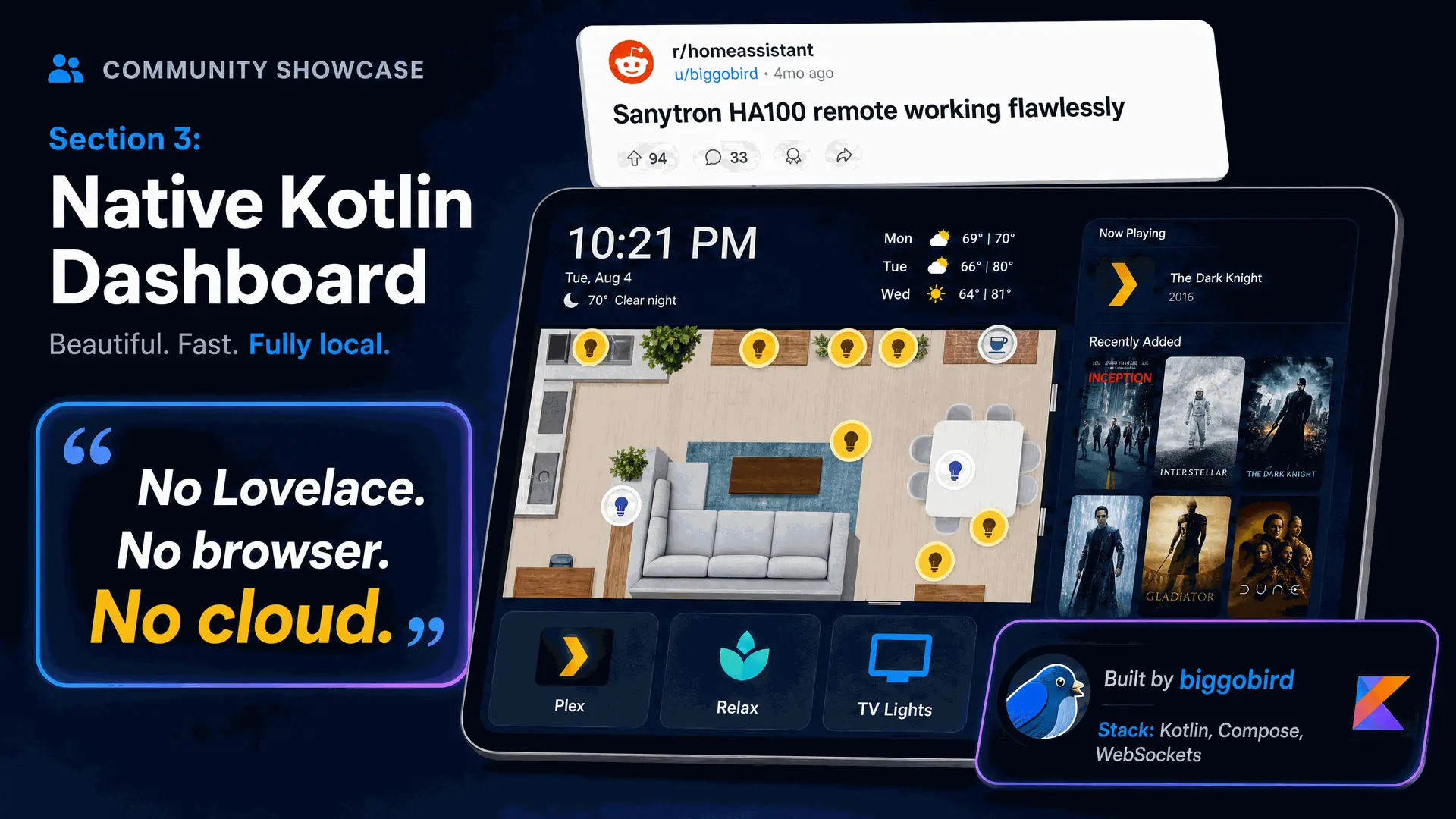
GitHub: https://github.com/vvaters/astrion-ha-dashboard
Community Voices That Changed Our Thinking
Not every contribution becomes code. Code is visible. Ideas are sometimes invisible. But both shape the future. Some of the most important ideas arrive as conversations.
Beyond the GitHub repositories, there were discussions that quietly reshaped how we think about Astrion. These didn't always arrive as pull requests, but their influence runs through many of the features people use today.
t0m1o1 — Home Assistant Hotkeys
One of the earliest community ideas that caught our attention came from t0m1o1. Rather than treating the remote as a standalone application, he focused on something much simpler: every physical button should become a native Home Assistant event. Instead of the traditional flow where a button press triggers remote logic that then talks to a device, his approach sent the button event directly to the Home Assistant event bus, where automations could respond in any way imaginable. This event-driven philosophy made Astrion feel much closer to Home Assistant itself. It also influenced many of our later discussions around physical button mapping, automation triggers, and eventually Activities.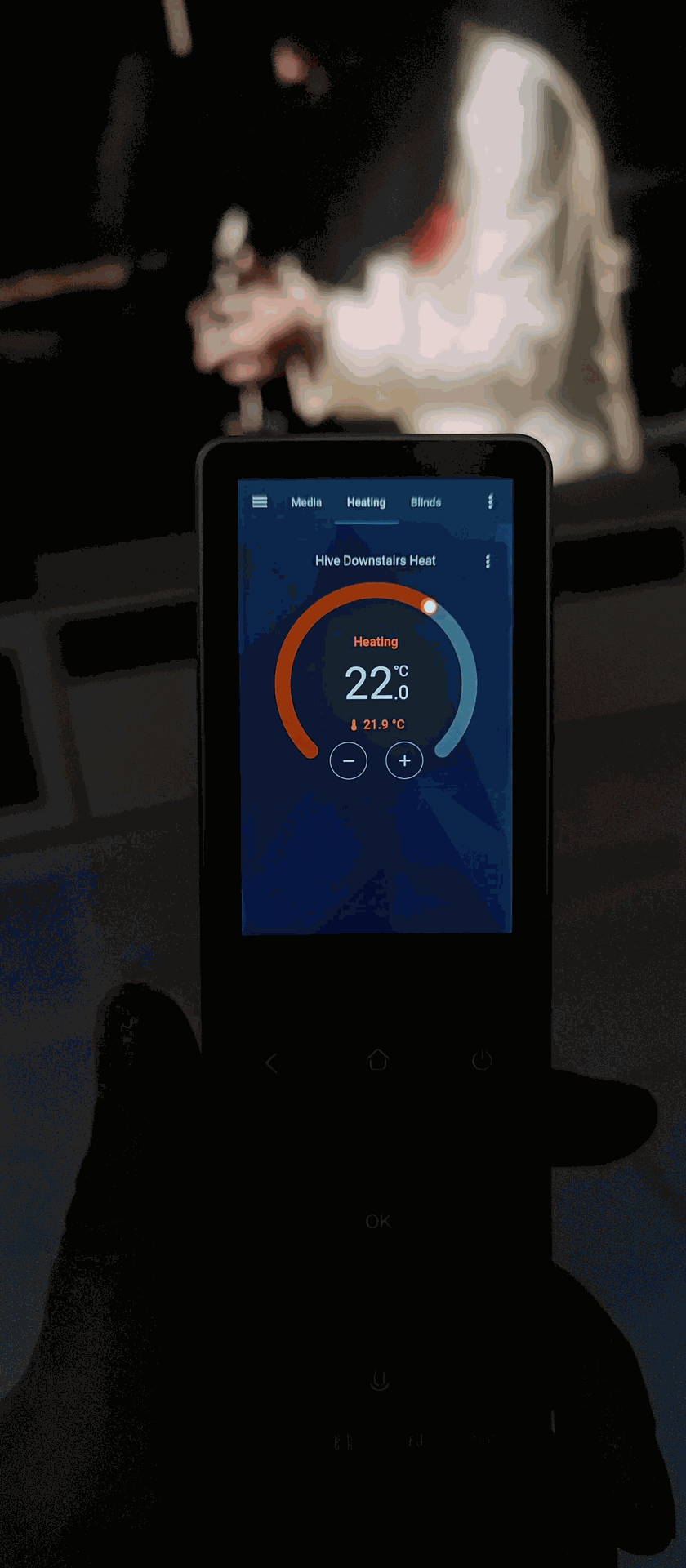
Brad — Fully Kiosk
Brad approached the problem from another direction. Instead of a handheld remote, he explored the idea of turning Android tablets into dedicated smart home control surfaces using Fully Kiosk Browser. It reminded us that Astrion and iPano don't have to compete with tablets. Instead, they can become different interfaces for different spaces: a wall panel in the kitchen, a handheld remote in the living room, a bedside controller, a desktop companion. Different form factors. One ecosystem.
Gary — Thinking in Activities
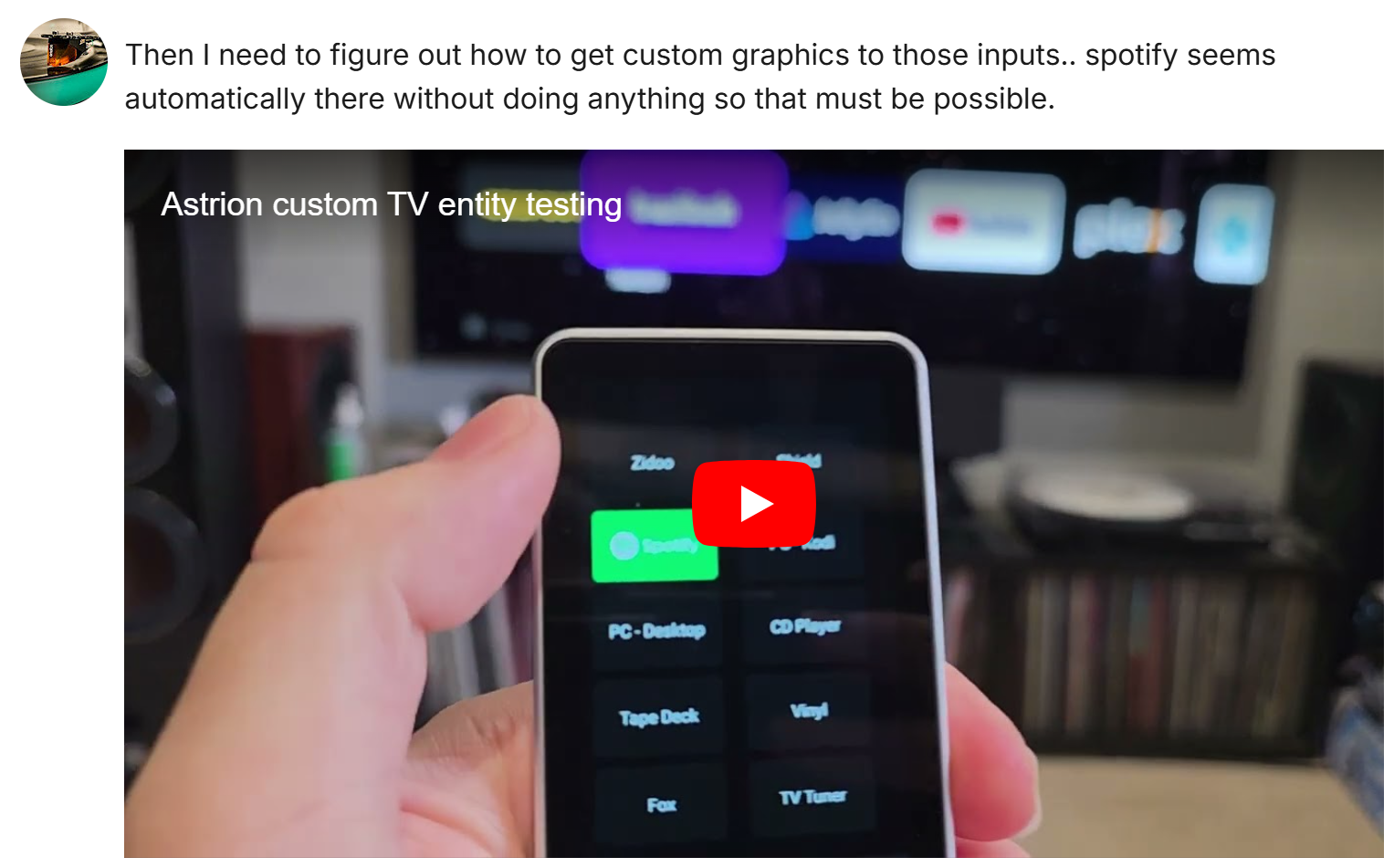
Gary consistently reminded us of something surprisingly important. People don't actually want to control devices. They want to watch a movie. Play music. Game. Relax. This subtle shift—from device-first to activity-first thinking—has influenced many of our recent discussions around Activities, Macros, and interface design. Instead of asking "Which device do you want?" the interface should eventually ask "What are you trying to do?"
Faceman — AV as a System
Faceman shared countless ideas around Android TV, media players, amplifiers, and AV workflows. His feedback consistently pushed us toward thinking beyond a single media player. A television isn't just a television. It's an ecosystem of devices that should work together naturally. Many of the improvements to TV cards, media workflows, and AV control were inspired by discussions like these.
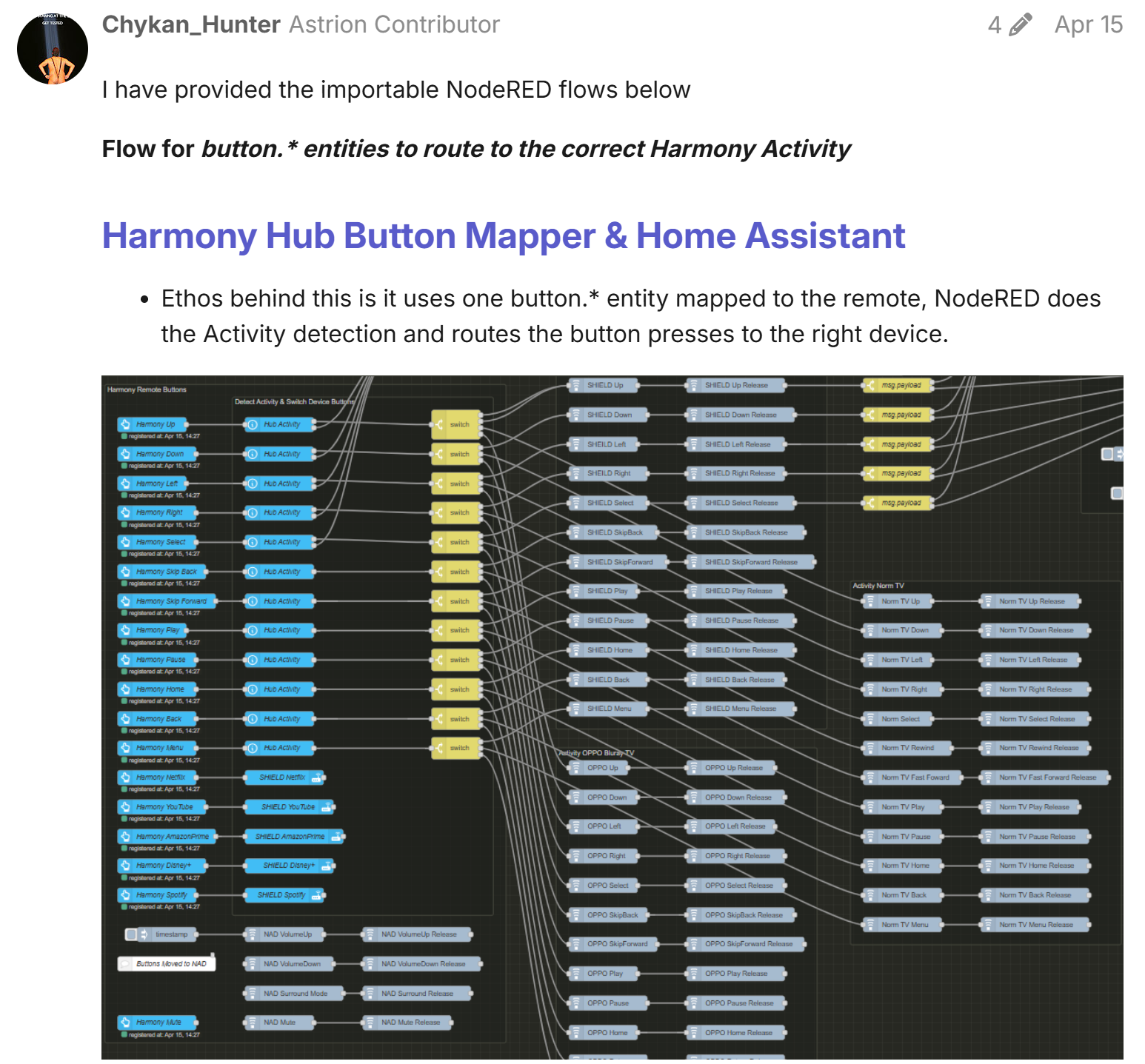
Chykan_Hunter — Beyond Individual Devices
If there is one community member who repeatedly challenged us to think bigger, it was Chykan_Hunter. His Node-RED examples weren't simply automations. They were complete interaction models. Instead of controlling one entity at a time, his flows coordinated multiple devices across different ecosystems using visual logic. A smart home is not a collection of devices. It is a collection of intentions, contexts, and experiences. Those discussions reinforced an idea we still believe today: Astrion shouldn't just send commands. It should participate in workflows.
Aurelien_PERARD & biggobird — Astrion as a Platform
More recently, Aurelien_PERARD and biggobird showed something equally exciting. Instead of asking us to add another feature, they simply built their own. Custom launchers. Native dashboards. Harmony integration. Compose UI. Alternative interaction models. Watching developers replace almost every layer of the software stack wasn't discouraging. It was exciting. Because it demonstrated that Astrion had become something larger than the software we originally shipped. It had become hardware that people wanted to build upon.
Hundreds of Smaller Ideas
Not every contribution comes as a GitHub repository or a forum essay. Many began as feature requests, small automation examples, or screenshots shared in passing.
Over the past year we've seen users share Node-RED automation flows, Harmony activity designs, RosCard layouts, dashboard concepts, IR mapping ideas, media workflows, accessibility improvements, voice assistant integrations, physical button strategies, and battery optimizations. Some eventually became official features. Others inspired future updates. Many simply helped another user solve a problem. Every one of them mattered.
Community Shapes the Product
Looking back at our firmware history, we realized something surprising.
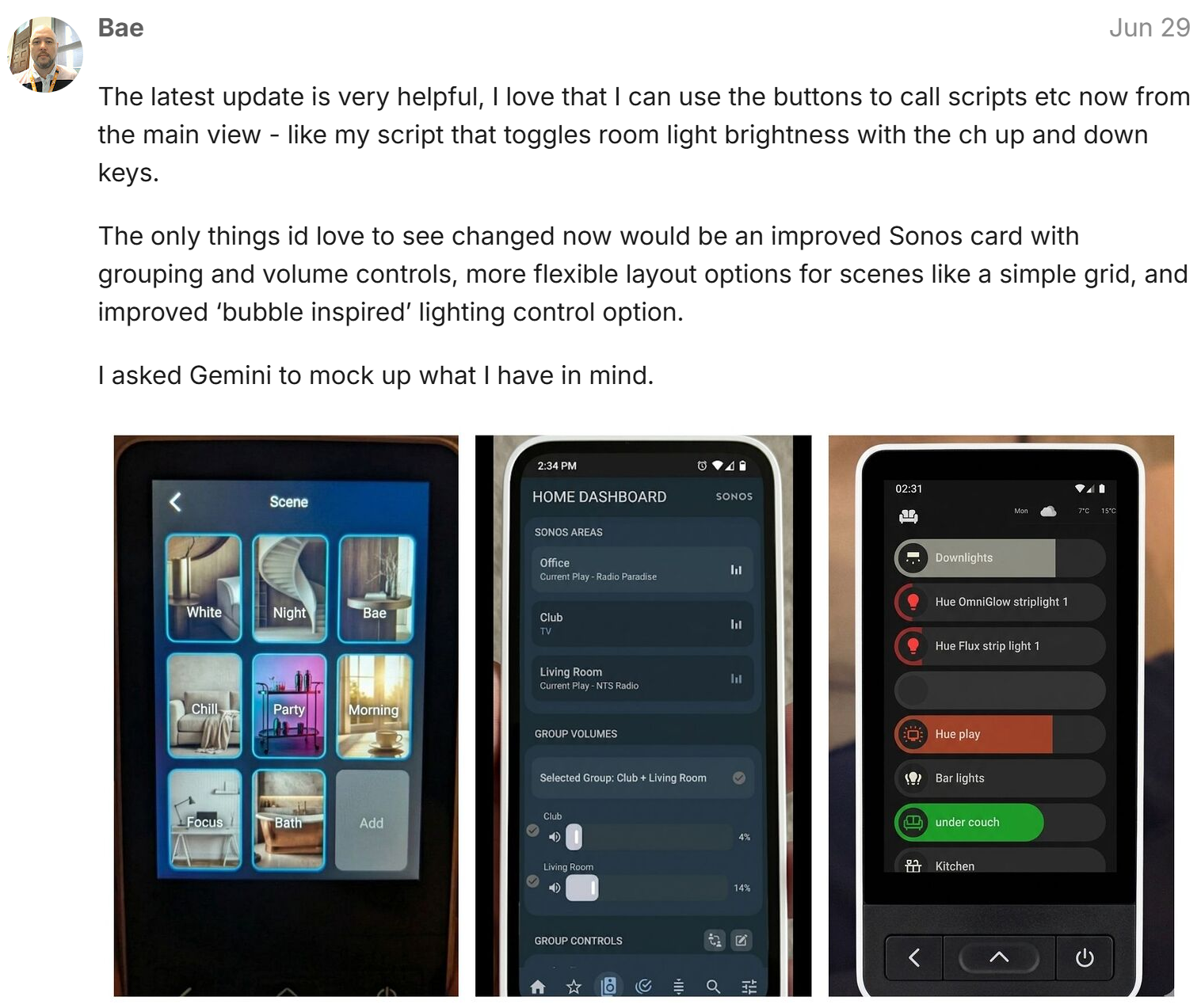
Many of the features people now associate with Astrion didn't originate inside our office. They originated in conversations. Custom button mapping. Harmony improvements. Activities. Weather cards. Cover support. Media workflows. RosCard enhancements. Even parts of our onboarding process. The community didn't just help us find bugs. It helped us discover better ideas.
A Platform, Not Just a Product
One of the most rewarding moments this year was seeing developers describe Astrion not as a remote, but as hardware they could build upon.
That wasn't part of our original roadmap. Yet today we have multiple independent projects using different philosophies, different UI frameworks, and different approaches to interacting with Home Assistant. Some prefer native Android. Some prefer Lovelace. Some build hybrid systems. Some experiment with Harmony. Others build entirely new experiences.
We don't think there's a single correct way. We think diversity is healthy. If Astrion can become a playground for experimentation, then we've achieved something far more valuable than shipping another firmware update.
From Community Experiments to a Hybrid Future
Watching these different approaches emerge taught us an important lesson.
There is no single "correct" interface for Home Assistant.
Some users love Lovelace freedom. Some prefer native performance. Some want physical buttons. Some want voice. Some want automation-driven experiences. The future should not force users to choose. It should allow different interaction models to coexist.
This idea is shaping the next generation of Astrion RemoteOS. Web interfaces. Native views. Physical controls. Intelligent routing. Different layers working together, each serving the right moment.
Because the best interface is not always the same interface.
It is the interface that appears at the right moment.
The Biggest Lesson
Looking back over the past year, we realized something.
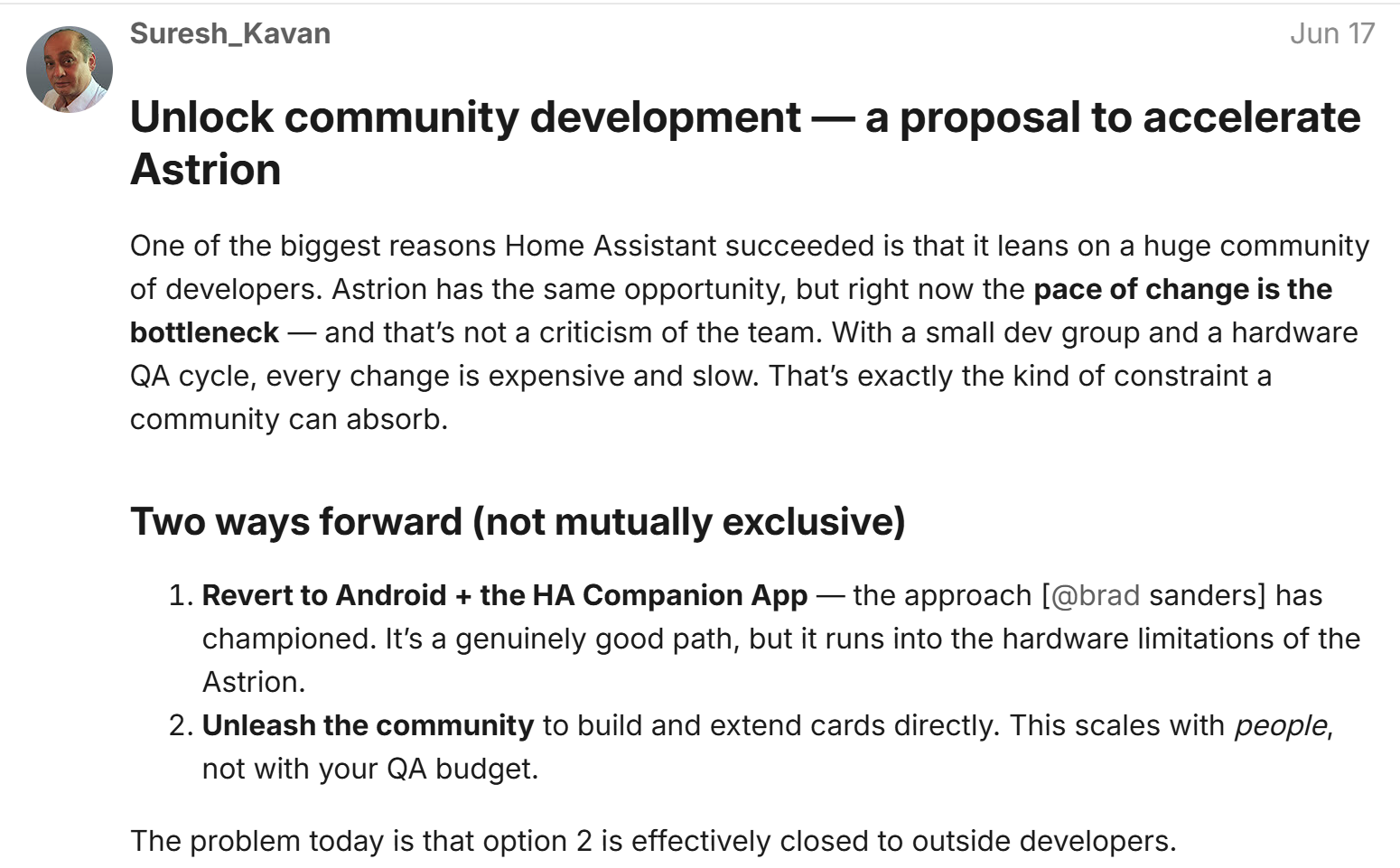
The most valuable contributions didn't always arrive as pull requests. Sometimes they were forum posts. Sometimes they were GitHub repositories. Sometimes they were screenshots. Sometimes they were feature requests. Sometimes they simply asked, "Have you considered doing it this way instead?"
Each one nudged Astrion in a slightly different direction. Individually, they seemed small. Together, they fundamentally changed what Astrion became.
And we think that's one of the most beautiful things about building in an open community.
Community Builders
| Community Builder | Contribution | Project |
|---|---|---|
Lanky-Reporter-7319 | Reverse engineering & community collaboration | — |
| t0m1o1 | HA Hotkeys & physical button framework | HA-hotkeys |
| Aurelien_PERARD | Custom launcher & Harmony integration | Astrion Custom Dashboard |
| biggobird | Kotlin Compose native dashboard | astrion-ha-dashboard |
| Chykan_Hunter | Node-RED workflows & advanced automation concepts | — |
| Faceman | Android TV & AV workflows | — |
| Gary | Activity-first interaction ideas | — |
| Brad | Wall panel and Fully Kiosk concepts | — |
Every bug report, feature request, pull request, forum post, and conversation has helped shape Astrion. If we missed your name here, please know that your contribution still matters—and we'd be honored to feature more community projects in future editions.
We'd Love to Feature Your Project
Have you created a custom launcher, a RosCard layout, a dashboard, a Home Assistant integration, a Node-RED flow, an automation package, an accessibility improvement, or a developer tool? We'd love to feature it. Whether it's a polished open-source project or a weekend experiment, we'd be happy to showcase it on Sanytron Hub so others can learn from it. Great ideas deserve to be shared.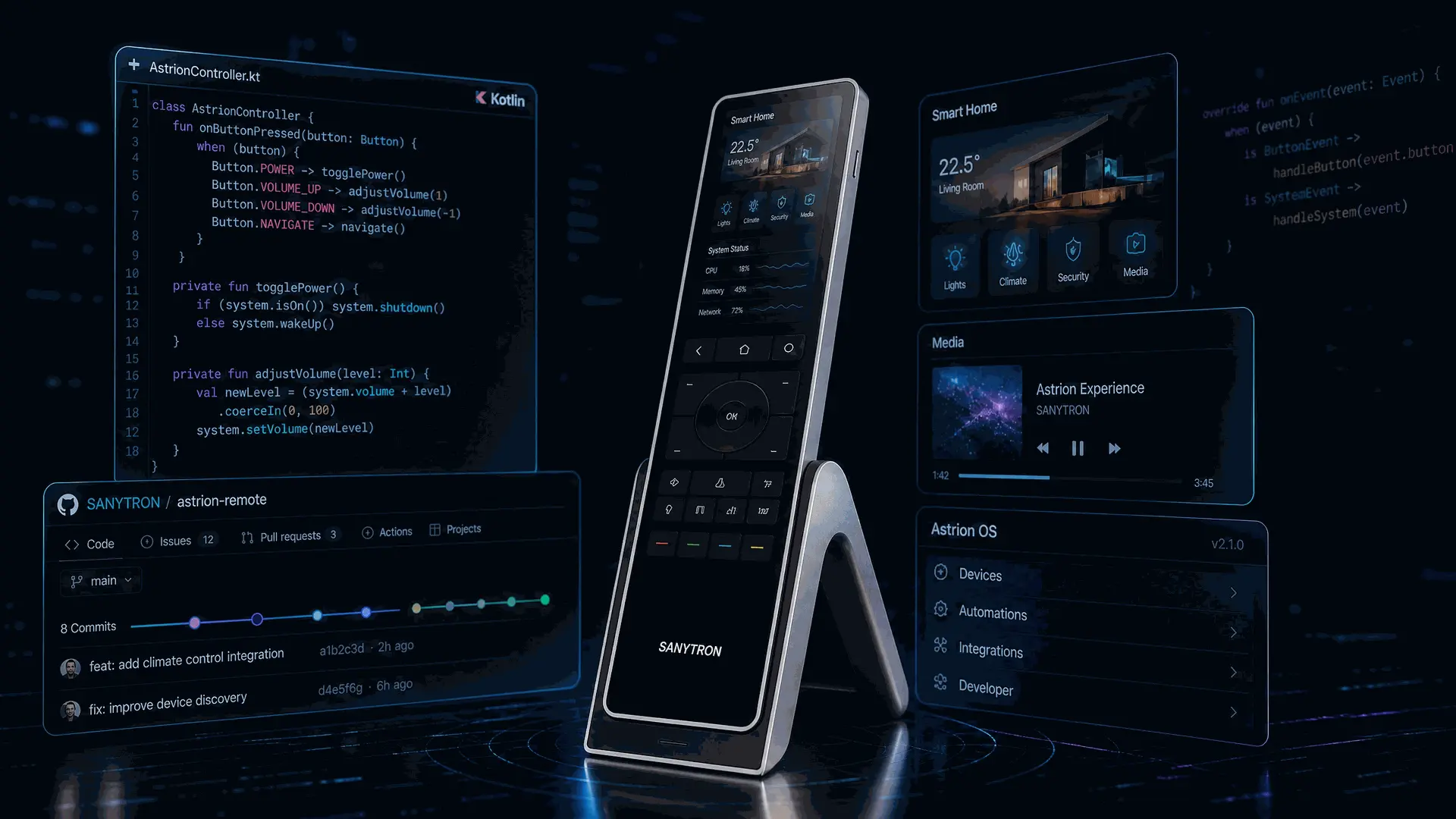
Thank You
To everyone who opened an issue, suggested a feature, reported a bug, published code, answered another user's question, or simply shared a screenshot of your setup—thank you. You didn't just help improve Astrion. You helped shape what Astrion has become.
We can't wait to see what the community builds next.
Together, we're building more than a remote.
We're exploring a new relationship between humans and their homes.
Not by replacing the freedom of Home Assistant,
but by extending it into the physical world.
Local-first.
Open.
Community-driven.
— The Astrion Team
Beyond the Remote: What the Community Built with Astrion